
Crastan Center
- comunicazione832
- Feb 5
- 2 min read
The renovation of the former Crastan building represents an urban transformation project capable of restoring centrality and a new identity to a historic site, reinterpreting it as a contemporary multifunctional hub. After an initial phase of selective demolition, the project focuses on repurposing the existing building, articulating different functions within a unified and recognizable structure.
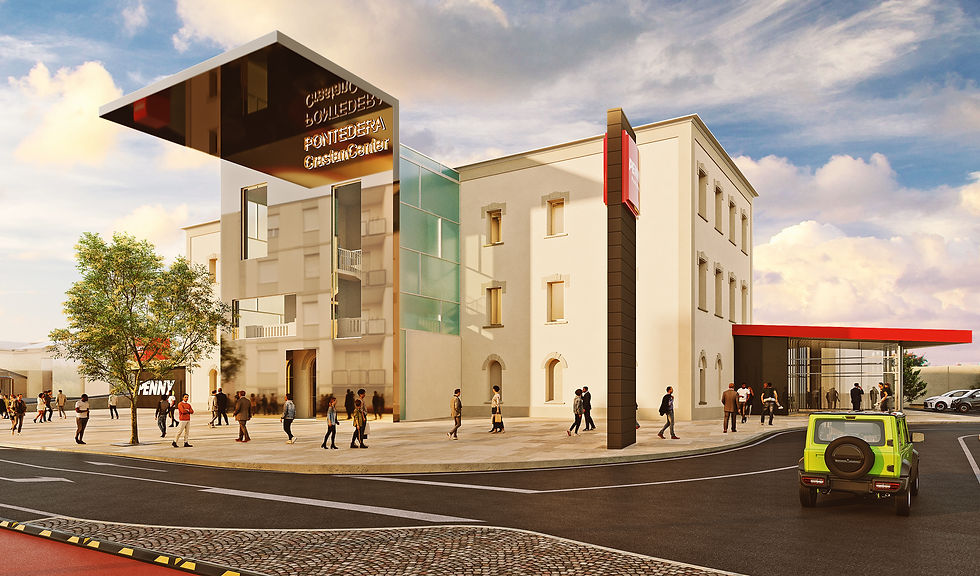
The new layout includes a commercial space on the ground floor for a medium-sized retail outlet, while the first and second floors house offices and executive suites. This functional stratification allows the building to return to being an active place throughout the day, strengthening its relationship with the public space and the surrounding urban fabric.

One of the central themes of the project is the dialogue between historical memory and contemporary architectural language. The upper floors preserve the shape and volume of the original historic building, maintaining the legibility of the pre-existing structure. On the ground floor, however, the design choice is to introduce a clear and decisive gesture: a new architectural volume on the north side, adjacent to the historic building, which expands the commercial area and houses functional ancillary spaces.
This extension does not camouflage the new intervention, but asserts its contemporaneity through modern materials and forms, without ever compromising the perception of the historic building. On the contrary, the controlled contrast between old and new becomes a tool for mutual enhancement.

The vertical connection between the levels is provided by a new stairwell with elevator, located in the existing central volume. Originally developed on a single floor, this structure has been raised with the addition of two new levels, taking on a key role from both a functional and architectural point of view. The intervention ensures full accessibility, in accordance with criteria of inclusivity and the removal of architectural barriers, but also becomes a symbolic element of the project.

The new facades of the elevated volume, partially glazed, introduce lightness and transparency, while a sculptural vertical metal wall, made of reflective sheet metal, stands out as a true urban landmark. This cladding emphasizes the verticality of the tower, captures light, sky, and movement, and opens up with vertical windows that reveal the internal functions.

Finally, the metal wall extends horizontally, transforming into a projecting canopy that protects the public area in front of the main entrance. An architectural gesture that is not only functional but also reinforces the public, open, and contemporary character of a building that is once again taking center stage in the city.


